Objectives: Topics
Objectives: Goals
-
Characterize and classify quadratic forms using eigenvalues and eigenvectors.
-
Express quadratic forms in the form \(Q(\vec x)=\vec x^{T}A\vec x\text{.}\)
-
Apply the principal axes theorem to remove cross-product terms.
Does the inequality below hold for all \(x,y\text{?}\)
\begin{equation*}
x_1^2-6x_1x_2+9x_2^2 \geq 0.
\end{equation*}
Definition 7.23. Quadratic Form.
\begin{equation*}
Q(\vec x)=\vec x^{T}A\vec x = \begin{bmatrix} x_1 \amp x_2 \amp \cdots \amp x_n \end{bmatrix} \begin{bmatrix} a_{1,1} \amp a_{1,2} \amp \cdots \amp a_{1,n} \\ a_{1,2} \amp a_{2,2} \amp \cdots \amp a_{2,n} \\ \vdots \amp \vdots \amp \ddots \amp \vdots \\ a_{1,n} \amp a_{2,n} \amp \cdots \amp a_{n,n} \end{bmatrix} \begin{bmatrix} x_1 \\ x_2 \\ \vdots \\ x_n \end{bmatrix},
\end{equation*}
Example 7.24.
Compute
\(Q_A(\vec x) = \vec x^{T}A\vec x\) and
\(Q_B(\vec x) = \vec x^{T}B\vec x\) for the following matrices.
(a)
\(A=\begin{bmatrix}4 \amp 0\\ 0 \amp 3\end{bmatrix}\)
(b)
\(B=\begin{bmatrix}4 \amp 1\\ 1 \amp -3\end{bmatrix}\)
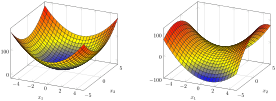
The graphs of the quadratic forms from
Example 7.24 are given below. Students are not expected to sketch quadratic surfaces.
As we will see shortly, properties of the symmetric matrix
\(A\) used to generate the quadratic form
\(Q_A(\vec x)\) will allow us to determine characterisitcs about the quadratic form, such as whether it is always nonnegative. Therefore, if first presented with the quadratic form, it is useful to find the symmetric matrix
\(A\) which generates the quadratic form.
Example 7.25.
Write the quadratic form below in the form
\(\vec x^{T}A\vec x\) for
\(\vec x\in\mathbb{R}^3\text{.}\)
\begin{equation*}
Q(\vec x)=5x_1^2+x_2^2+3x_3^2+6x_1x_3-12x_2x_3.
\end{equation*}
Note in the above example it is difficult to determine whether
\(Q(\vec x)\) is always nonnegative. This is due to the cross-product terms, terms of the form
\(x_ix_j\text{,}\) since these terms could be positive or negative depending on the input.
To help us better determine properties of
\(Q(\vec x)\text{,}\) we would like to perform a
change of variables to obtain an equivalent quadratic form
\(Q(\vec y)\) which no longer has any cross-product terms. Recall that we can find a symmetric matrix
\(A\) so that
\(Q(\vec x) = \vec x^T A \vec x\text{.}\) Since
\(A\) is symmetric, we know by
Theorem 7.18 that
\(A = PDP^T\) for a diagonal matrix
\(D\) and orthogonal matrix
\(P\text{.}\)
What happens when we make the change of variables
\(\vec x = P\vec y\text{?}\)
Theorem 7.26. Principal Axes Theorem.
If
\(A\) is symmetric, then there exists an orthogonal change of variables
\(\vec x=P\vec y\) such that the quadratic form
\(\vec x^{T}A\vec x\) becomes
\(\vec y^{T}D\vec y\text{,}\) with no cross-product terms.
Example 7.27.
Use the orthogonal diagonalization of
\(A\) to remove cross-product terms from
\(Q=\vec x^{T}A\vec x\text{.}\)
\begin{equation*}
A=\begin{bmatrix}3 \amp 2\\ 2 \amp 6\end{bmatrix}
=PDP^{T} = \frac{1}{\sqrt5}\begin{bmatrix}2 \amp 1\\ -1 \amp 2\end{bmatrix}\begin{bmatrix}2 \amp 0\\ 0 \amp 7\end{bmatrix}\frac{1}{\sqrt5}\begin{bmatrix}2 \amp -1\\ 1 \amp 2\end{bmatrix}
\end{equation*}