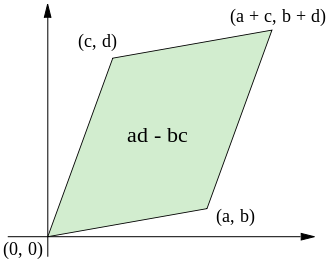
Theorem3.21.Volume Scaling by a Linear Transformation.
If \(T_A:\mathbb{R}^n\to\mathbb{R}^n\) is the linear transformation defined by \(T_A(\vec x)=A\vec x\text{,}\) and \(S\) is any closed shape in \(\mathbb{R}^n\text{,}\) then
Recall from Section 1.9 that the matrix corresponding to a shearing linear transformation has the from \(\begin{bmatrix} 1 \amp k \\ 0 \amp 1 \end{bmatrix}\) or \(\begin{bmatrix} 1 \amp 0 \\ k \amp 1 \end{bmatrix}\text{.}\) Since each of these matrices has determinant 1, we see that shearing does not change the area of a shape.
Note that \(S\) can be any closed shape. This includes parallelograms, polygons, circles, or crazy blobs, as long as the edge of the shape is connected.
Let \(A \) be an invertible \(n \times n\) matrix and let \(\vec b \in \mathbb{R}^n\text{.}\) Then the system \(A\vec x = \vec b\) has the unique solution \(\vec x\) whose entires are given by