Section 1.9 More on Linear Transformations

Handout 1.9 More on Linear Transformation

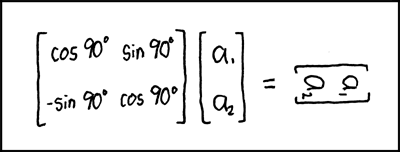
Comic showing a humorous matrix transformation.

Definition 1.56. The Standard Vectors.

The standard vectors in \(\mathbb{R}^n\) are the vectors \(\vec e_1, \vec e_2, \ldots, \vec e_n\text{.}\)
They are:
\begin{equation*} \vec e_1 = \begin{bmatrix} 1 \\ 0 \\ \vdots \\ 0 \end{bmatrix}, \qquad \vec e_2 = \begin{bmatrix} 0 \\ 1 \\ \vdots \\ 0 \end{bmatrix}, \qquad \ldots, \qquad \vec e_n = \begin{bmatrix} 0 \\ 0 \\ \vdots \\ 1 \end{bmatrix}. \end{equation*}
For example, in \(\mathbb{R}^3\text{:}\)
\begin{equation*} \vec e_1=\begin{bmatrix}1\\0\\0\end{bmatrix}, \qquad \vec e_2=\begin{bmatrix}0\\1\\0\end{bmatrix}, \qquad \vec e_3=\begin{bmatrix}0\\0\\1\end{bmatrix}. \end{equation*}
Note: If \(A\) is an \(m\times n\) matrix with columns \(\vec v_1,\vec v_2,\ldots,\vec v_n\text{,}\) then
\begin{equation*} A\vec e_i = \vec v_i, \text{ for } i=1,2,\ldots,n. \end{equation*}
So multiplying a matrix by \(\vec e_i\) gives column \(i\) of \(A\text{.}\)

Example 1.57. Example.

Compute:
\begin{equation*} \begin{bmatrix} 1 \amp 2 \amp 3\\ 4 \amp 5 \amp 6\\ 7 \amp 8 \amp 9 \end{bmatrix}\vec e_2. \end{equation*}
The matrix \(A\) is the standard matrix for the linear transformation \(T\text{.}\)

Example 1.59.

What is the linear transformation \(T:\mathbb{R}^2 \to \mathbb{R}^2\) defined by β€œrotates vectors counterclockwise by angle \(\theta\)”?
There is a long list of geometric transformations of \(\mathbb{R}^2\) in many linear algebra texts (reflections, rotations, contractions and expansions, shears, projections, and more). Several are included at the end of this section.

Definition 1.60. Onto.

A linear transformation \(T:\mathbb{R}^n \to \mathbb{R}^m\) is onto if for every \(\vec b\in \mathbb{R}^m\) there exists \(\vec x\in \mathbb{R}^n\) such that \(T(\vec x)=\vec b\text{.}\) In otherwords, a linear transformation is onto if the range of \(T\) equals the codomain of \(T\text{.}\)
Onto is an existence property: for any \(\vec b\in\mathbb{R}^m\text{,}\) the system \(A\vec x=\vec b\) has a solution (where \(A\) is the standard matrix of \(T\)).
Examples
  • A rotation on the plane is onto.
  • A projection in the plane is not onto.

Definition 1.62. One-to-One.

A linear transformation \(T:\mathbb{R}^n \to \mathbb{R}^m\) is one-to-one if for every \(\vec b\in\mathbb{R}^m\) there is at most one (possibly none) \(\vec x\in\mathbb{R}^n\) such that \(T(\vec x)=\vec b\text{.}\)
One-to-one is a uniqueness property; it does not assert existence for all \(\vec b\text{.}\)
Examples
  • A rotation on the plane is one-to-one.
  • A projection in the plane is not one-to-one.

Example 1.64.

Complete the matrices below by entering numbers into the missing entries so that the stated properties are satisfied. If it isn’t possible, state why.
(a)
\(A\) is a \(2\times 3\) standard matrix for a one-to-one linear transformation.
\begin{equation*} A= \begin{bmatrix} 1 \amp 0 \amp \\ 0 \amp \amp 1 \end{bmatrix}. \end{equation*}
(b)
\(B\) is a \(3\times 2\) standard matrix for an onto linear transformation.
\begin{equation*} B= \begin{bmatrix} 1 \amp \\ \amp \\ \amp \end{bmatrix}. \end{equation*}
(c)
\(C\) is a \(3\times 3\) standard matrix of a linear transformation that is one-to-one and onto.
\begin{equation*} C= \begin{bmatrix} 1 \amp 1 \amp 1\\ \amp \amp \\ \amp \amp \end{bmatrix}. \end{equation*}

Example 1.65.

Define a linear transformation by
\begin{equation*} T(x_1,x_2)=(3x_1+x_2,\; 5x_1+7x_2,\; x_1+3x_2). \end{equation*}
Is \(T\) one-to-one? Is \(T\) onto?
Below are many examples of linear transformations from \(\mathbb{R}^2\) to \(\mathbb{R}^2\text{.}\)
transformation image of unit square standard matrix
reflection through \(x_1\)-axis
Unit square reflected across the horizontal axis.
Relection across \(x_2 = 0\)
\(\begin{bmatrix}1\amp 0\\0\amp -1\end{bmatrix}\)
reflection through \(x_2\)-axis
Unit square reflected across the vertical axis.
Relection across \(x_1 = 0\)
\(\begin{bmatrix}-1\amp 0\\0\amp 1\end{bmatrix}\)
reflection through \(x_2=x_1\)
Unit square reflected across diagonal line passing through (0,0) and (1,1).
Reflection across \(x_2=x_1\text{.}\)
\(\begin{bmatrix}0\amp 1\\1\amp 0\end{bmatrix}\)
reflection through \(x_2=-x_1\)
Unit square reflected across the diagonal line passing through (0,0) and (1,-1).
Reflection across \(x_2=-x_1\text{.}\)
\(\begin{bmatrix}0\amp -1\\-1\amp 0\end{bmatrix}\)
transformation image of unit square standard matrix
Horizontal contraction
Unit square compressed horizontally toward the vertical axis.
Horizontal contraction by factor \(k\) with \(|k|<1\text{.}\)
\(\begin{bmatrix}k\amp 0\\0\amp 1\end{bmatrix}\text{,}\) \(|k|<1\)
Horizontal expansion
Unit square stretched horizontally away from the vertical axis.
Horizontal expansion by factor \(k\) with \(k>1\text{.}\)
\(\begin{bmatrix}k\amp 0\\0\amp 1\end{bmatrix}\text{,}\) \(k>1\)
Vertical contraction
Unit square compressed vertically toward the horizontal axis.
Vertical contraction by factor \(k\) with \(|k|<1\text{.}\)
\(\begin{bmatrix}1\amp 0\\0\amp k\end{bmatrix}\text{,}\) \(|k|<1\)
Vertical expansion
Unit square stretched vertically away from the horizontal axis.
Vertical expansion by factor \(k\) with \(k>1\text{.}\)
\(\begin{bmatrix}1\amp 0\\0\amp k\end{bmatrix}\text{,}\) \(k>1\)
transformation image of unit square standard matrix
Horizontal shear (left)
Unit square sheared left by a horizontal shift.
Horizontal shear with parameter \(k<0\text{.}\)
\(\begin{bmatrix}1\amp k\\0\amp 1\end{bmatrix}\text{,}\) \(k<0\)
Horizontal shear (right)
Unit square sheared right by a horizontal shift.
Horizontal shear with parameter \(k>0\text{.}\)
\(\begin{bmatrix}1\amp k\\0\amp 1\end{bmatrix}\text{,}\) \(k>0\)
Vertical shear (down)
Unit square sheared downward by a vertical shift.
Vertical shear with parameter \(k<0\text{.}\)
\(\begin{bmatrix}1\amp 0\\k\amp 1\end{bmatrix}\text{,}\) \(k<0\)
Vertical shear (up)
Unit square sheared upward by a vertical shift.
Vertical shear with parameter \(k>0\text{.}\)
\(\begin{bmatrix}1\amp 0\\k\amp 1\end{bmatrix}\text{,}\) \(k>0\)
transformation image of unit square standard matrix
Projection onto the \(x_1\)-axis
Unit square flattened onto the horizontal axis.
Projection onto \(x_1\)-axis.
\(\begin{bmatrix}1\amp 0\\0\amp 0\end{bmatrix}\)
Projection onto the \(x_2\)-axis
Unit square flattened onto the vertical axis.
Projection onto \(x_2\)-axis.
\(\begin{bmatrix}0\amp 0\\0\amp 1\end{bmatrix}\)