Skip to main content
Contents Embed Dark Mode Prev Up Next \(\newcommand{\foo}{b^{ar}}
\newcommand{\aug}{\fboxsep=-\fboxrule\!\!\!\fbox{\strut}\!\!\!}
\newcommand{\Nul}{\operatorname{Nul}}
\newcommand{\Col}{\operatorname{Col}}
\newcommand{\Row}{\operatorname{Row}}
\newcommand{\Span}{\operatorname{Span}}
\renewcommand{\det}{\operatorname{det}}
\newcommand{\rank}{\operatorname{rank}}
\newcommand{\proj}{\operatorname{proj}}
\newcommand{\dist}{\operatorname{dist}}
\newcommand{\lt}{<}
\newcommand{\gt}{>}
\newcommand{\amp}{&}
\definecolor{fillinmathshade}{gray}{0.9}
\newcommand{\fillinmath}[1]{\mathchoice{\colorbox{fillinmathshade}{$\displaystyle \phantom{\,#1\,}$}}{\colorbox{fillinmathshade}{$\textstyle \phantom{\,#1\,}$}}{\colorbox{fillinmathshade}{$\scriptstyle \phantom{\,#1\,}$}}{\colorbox{fillinmathshade}{$\scriptscriptstyle\phantom{\,#1\,}$}}}
\)
Section 5.5 Complex Eigenvalues
Handout 5.5 Complex Eigenvalues
Objectives: Topics
Complex numbers: addition, multiplication, complex conjugate
Complex eigenvalues and eigenvectors
Eigenvalue theorems
Objectives: Goals
Use eigenvalues to identify the rotation and dilation of a linear transform.
Recognize rotation–dilation matrices.
Find complex eigenvalues and eigenvectors of a real matrix.
Apply theorems to characterize matrices with complex eigenvalues.
Example 5.41 .
Consider the linear transformation
\(T: \mathbb{R}^2 \rightarrow \mathbb{R}^2\) which rotates vectors counterclockwise by 90
\(^\circ\text{.}\)
(a) Find the matrix
\(A\) so that
\(T(\vec x) = A\vec x\text{.}\)
(b) Find the characteristic polynomial of
\(A\text{.}\)
(c) What are the eigenvalues of
\(A\text{?}\)
Definition 5.42 . Complex Numbes.
The complex numbers are denoted by \(\mathbb{C}\text{,}\) where
\begin{equation*}
\mathbb{C}=\{\,a+bi \mid a,b\in\mathbb{R}\,\}.
\end{equation*}
We can identify
\(\mathbb{C}\) with
\(\mathbb{R}^2\) via
\(a+bi \leftrightarrow (a,b)\text{.}\)
We can add and multiply complex numbers by treating
\(i\) as variable and simplifying powers of
\(i\) appropriately.
Example 5.43 .
Let
\(z_1 = 2 - 3i\) and let
\(z_2 = -1 + i\text{.}\) Calculate the following:
(a) Sum of complex numbers:
\(z_1 + z_2\)
(b) Product of complex numbers:
\(z_1z_2\)
Definition 5.44 . Complex Conjugate.
The
conjugate of
\(a+bi\) is
\(\overline{a+bi}=a-bi\text{.}\)
Definition 5.45 . Absolute Value (Modulus).
The
absolute value (modulus) of
\(a+bi\) is
\(\lvert a+bi\rvert=\sqrt{a^2+b^2}\text{.}\)
Definition 5.46 .
Example 5.47 .
Given
\(z=3-4i\text{,}\) compute
\(\overline{z}\text{,}\) \(\lvert z\rvert\text{,}\) and the polar form of
\(z\text{.}\)
Theorem 5.48 . Conjugate Properties.
Let \(x,y\in\mathbb{C}\) and \(\vec v\in\mathbb{C}^n\text{.,}\) Then we have the following properties:
\(\displaystyle \overline{(x+y)}=\overline{x}+\overline{y}\)
\(\displaystyle \overline{(xy)}=\overline{x} \ \overline{y}\)
\(\overline{A\vec v}=A\,\overline{\vec v}\) (for a real matrix \(A\) )
\(\displaystyle \operatorname{Im}(x\overline{x})=0\)
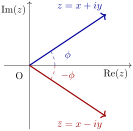
Conjugation reflects points across the real axis.
The point \(z=x+iy\) at angle \(\phi\) reflects to \(\overline{z}=x-iy\) at angle \(-\phi\) across the real axis.
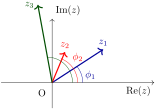
Vectors representing \(z_1\text{,}\) \(z_2\text{,}\) and their product \(z_3=z_1z_2\) with angles adding: \(\phi_3=\phi_1+\phi_2\text{.}\)
Theorem 5.49 . Fundamental Theorem of Algebra.
Every polynomial of degree
\(n\) has exactly
\(n\) complex roots, counting multiplicity.
Theorem 5.50 . Conjugate Pairs for Real Coefficients.
If \(\lambda\in\mathbb{C}\) is a root of a real polynomial \(p(x)\text{,}\) then the conjugate \(\overline{\lambda}\) is also a root of \(p(x)\text{.}\)
If \(\lambda\) is an eigenvalue of a real matrix \(A\) with eigenvector \(\vec v\text{,}\) then \(\overline{\lambda}\) is an eigenvalue of \(A\) with eigenvector \(\overline{\vec v}\text{.}\)
Example 5.51 .
Four eigenvalues of a
\(7\times 7\) real matrix
\(A\) are
\(-2\text{,}\) \(4+i\text{,}\) \(-4-i\text{,}\) and
\(i\text{.}\) What are the other eigenvalues?
Example 5.52 .
The matrix that rotates vectors by
\(\phi=\pi/4\) about the origin and then scales by
\(r=\sqrt{2}\) is
\begin{equation*}
A=
\begin{bmatrix}
r \amp 0\\
0 \amp r
\end{bmatrix}
\begin{bmatrix}
\cos\phi \amp -\sin\phi\\
\sin\phi \amp \cos\phi
\end{bmatrix}
=
\begin{bmatrix}
1 \amp -1\\
1 \amp 1
\end{bmatrix}.
\end{equation*}
Find the eigenvalues of
\(A\) and one eigenvector for each eigenvalue.
The previous example is a special case of the real
rotation–dilation matrix
\(C=\begin{bmatrix} a \amp -b\\ b \amp a \end{bmatrix}\text{.}\)
Example 5.53 .
Compute the eigenvalues of
\begin{equation*}
C=\begin{bmatrix} a \amp -b\\ b \amp a \end{bmatrix}
\end{equation*}
and express them in the polar form
\(re^{i\phi}\text{.}\)
Example 5.54 .
Find the complex eigenvalues and an associated complex eigenvector for each eigenvalue of
\begin{equation*}
A=\begin{bmatrix}
1 \amp -2\\
1 \amp 3
\end{bmatrix}.
\end{equation*}