Skip to main content
Contents Embed Dark Mode Prev Up Next \(\newcommand{\foo}{b^{ar}}
\newcommand{\aug}{\fboxsep=-\fboxrule\!\!\!\fbox{\strut}\!\!\!}
\newcommand{\Nul}{\operatorname{Nul}}
\newcommand{\Col}{\operatorname{Col}}
\newcommand{\Row}{\operatorname{Row}}
\newcommand{\Span}{\operatorname{Span}}
\renewcommand{\det}{\operatorname{det}}
\newcommand{\rank}{\operatorname{rank}}
\newcommand{\proj}{\operatorname{proj}}
\newcommand{\dist}{\operatorname{dist}}
\newcommand{\lt}{<}
\newcommand{\gt}{>}
\newcommand{\amp}{&}
\definecolor{fillinmathshade}{gray}{0.9}
\newcommand{\fillinmath}[1]{\mathchoice{\colorbox{fillinmathshade}{$\displaystyle \phantom{\,#1\,}$}}{\colorbox{fillinmathshade}{$\textstyle \phantom{\,#1\,}$}}{\colorbox{fillinmathshade}{$\scriptstyle \phantom{\,#1\,}$}}{\colorbox{fillinmathshade}{$\scriptscriptstyle\phantom{\,#1\,}$}}}
\)
Section 2.3 The Invertible Matrix Theorem
Handout 2.3 The Invertible Matrix Theorem
A synonym is a word you use when you can’t spell the other one.
―
The theorem introduced in this section provides many equivalent ways of describing the same idea. Depending on the context, some formulations will be more convenient than others.
Objectives: Topics
Objectives: Goals
Motivating Question : When is a square matrix invertible? Let me count the ways!
Invertible matrices enjoy a rich set of equivalent descriptions.
Theorem 2.26 . The Invertible Matrix Theorem (IMT).
Let
\(A\) be an
\(n\times n\) matrix. The following statements are equivalent.
\(A\) is invertible.
\(A\) is row equivalent to \(I_n\text{.}\)
\(A\) has \(n\) pivotal columns.
\(A\vec x=\vec 0\) has only the trivial solution.
The columns of \(A\) are linearly independent.
The linear transformation \(\vec x \mapsto A\vec x\) is one-to-one.
The equation \(A\vec x=\vec b\) has a solution for all \(\vec b\in\mathbb{R}^n\text{.}\)
The columns of \(A\) span \(\mathbb{R}^n\text{.}\)
The linear transformation \(\vec x \mapsto A\vec x\) is onto.
There is an \(n\times n\) matrix \(C\) such that \(CA=I_n\text{.}\) (\(A\) has a left inverse.)
There is an \(n\times n\) matrix \(D\) such that \(AD=I_n\text{.}\) (\(A\) has a right inverse.)
\(A^T\) is invertible.
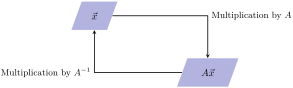
The diagram below provides another perspective on the role of the inverse matrix.
Diagram shows \(\vec x\text{,}\) transformed by multiplication by \(A\text{,}\) and reversed by multiplication by \(A^{-1}\text{.}\)
The matrix inverse \(A^{-1}\) transforms \(A\vec x\) back to \(\vec x\text{,}\) because
\begin{equation*}
A^{-1}(A\vec x)=(A^{-1}A)\vec x=\vec x.
\end{equation*}
Some comments on IMT:
The Invertible Matrix Theorem divides all square matrices into two classes: invertible and non-invertible.
As the course progresses, additional equivalent conditions involving determinants, eigenvalues, and other concepts will be added.
Note that items (j) and (k) of the Invertible Matrix Theorem lead directly to the following result.
Theorem 2.27 . Left and Right Inverses.
If
\(A\) and
\(B\) are
\(n\times n\) matrices and
\(AB=I\text{,}\) then both matrices are invertible, with
\(B=A^{-1}\) and
\(A=B^{-1}\text{.}\)
Example 2.28 .
\begin{equation*}
A = \begin{bmatrix}
1 \amp 0 \amp -2\\
3 \amp 1 \amp -2\\
-5 \amp -1 \amp 9
\end{bmatrix}
\end{equation*}
Example 2.29 .
For each matrix below, determine all values of
\(h\) so that the matrix is singular (not invertible). If there are no values of
\(h \text{,}\) explain why.
(a)
\(A = \begin{bmatrix}
1 \amp 0 \amp 1\\
1 \amp h \amp 1\\
0 \amp 0 \amp 1
\end{bmatrix}\)
(b)
\(B = \begin{bmatrix}
1 \amp h \amp 1\\
0 \amp 1 \amp 1\\
0 \amp 0 \amp 1
\end{bmatrix}\)
(c)
\(C = \begin{bmatrix}
1 \amp 0 \amp 0\\
0 \amp 1 \amp 1\\
0 \amp h \amp 1
\end{bmatrix}\)