Skip to main content
Contents Embed Dark Mode Prev Up Next \(\newcommand{\foo}{b^{ar}}
\newcommand{\aug}{\fboxsep=-\fboxrule\!\!\!\fbox{\strut}\!\!\!}
\newcommand{\Nul}{\operatorname{Nul}}
\newcommand{\Col}{\operatorname{Col}}
\newcommand{\Row}{\operatorname{Row}}
\newcommand{\Span}{\operatorname{Span}}
\renewcommand{\det}{\operatorname{det}}
\newcommand{\rank}{\operatorname{rank}}
\newcommand{\proj}{\operatorname{proj}}
\newcommand{\dist}{\operatorname{dist}}
\newcommand{\lt}{<}
\newcommand{\gt}{>}
\newcommand{\amp}{&}
\definecolor{fillinmathshade}{gray}{0.9}
\newcommand{\fillinmath}[1]{\mathchoice{\colorbox{fillinmathshade}{$\displaystyle \phantom{\,#1\,}$}}{\colorbox{fillinmathshade}{$\textstyle \phantom{\,#1\,}$}}{\colorbox{fillinmathshade}{$\scriptstyle \phantom{\,#1\,}$}}{\colorbox{fillinmathshade}{$\scriptscriptstyle\phantom{\,#1\,}$}}}
\)
Section 6.4 Gram–Schmidt and QR Decomposition
Handout 6.4 Gram–Schmidt and QR Decomposition
Objectives: Topics
The Gram–Schmidt Process
The QR decomposition
Objectives: Goals
Identify an orthogonal basis for the subspace spanned by:
\begin{equation*}
\vec x_1=\begin{bmatrix}1\\1\\1\\1\end{bmatrix},\quad
\vec x_2=\begin{bmatrix}0\\1\\1\\1\end{bmatrix},\quad
\vec x_3=\begin{bmatrix}0\\0\\1\\1\end{bmatrix}.
\end{equation*}
Theorem 6.44 . The Gram–Schmidt Process.
Given a basis
\(\{\vec x_1,\dots,\vec x_p\}\) for a subspace
\(W \subseteq \mathbb{R}^n\text{,}\) define:
\begin{align*}
\vec v_1 \amp =\vec x_1,\\
\vec v_2 \amp = \vec x_2 - \frac{\vec x_2\cdot\vec v_1}{\vec v_1\cdot\vec v_1}\vec v_1,\\
\vec v_3 \amp = \vec x_3 - \frac{\vec x_3\cdot\vec v_1}{\vec v_1\cdot\vec v_1}\vec v_1
- \frac{\vec x_3\cdot\vec v_2}{\vec v_2\cdot\vec v_2}\vec v_2,\\
\amp \vdots\\
\vec v_p \amp = \vec x_p - \frac{\vec x_p\cdot\vec v_1}{\vec v_1\cdot\vec v_1}\vec v_1 - \cdots - \frac{\vec x_p \cdot \vec v_{p-1}}{\vec v_{p-1} \cdot \vec v_{p-1}}\vec v_{p-1}.
\end{align*}
Then \(\{\vec v_1,\dots,\vec v_p\}\) is an orthogonal basis for \(W\text{.}\) Additionally,
\begin{equation*}
W_k = \Span\left\{\vec v_1, \dots, \vec v_k\right\} = \Span\left\{\vec x_1, \dots, \vec x_k\right\} \qquad \text{for $1 \leq k \leq p$}\text{.}
\end{equation*}
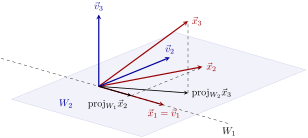
Thus, we see that each vector \(\vec v_k\) is formed by starting with \(\vec x_k\) and then removing the orthogonal projection of \(\vec x_k\) onto \(W_{k-1}\text{;}\) that is,
\begin{equation*}
\vec v_k = \vec x_k - \proj_{W_{k-1}}\vec x_k = \vec x_k - \proj_{\vec v_1}\vec x_k - \cdots - \proj_{\vec v_{k-1}}\vec x_k\text{.}
\end{equation*}
Vectors \(\vec x_1,\vec x_2,\vec x_3\) are used to produce orthogonal vectors \(\vec v_1,\vec v_2,\vec v_3\) via subtraction of projections.
Gram–Schmidt successively removes the components of each vector in the span of earlier ones.
Example 6.45 .
Let
\(W = \Span\left\{\begin{bmatrix} 3 \\ 0 \\ -1 \end{bmatrix}, \begin{bmatrix} 8 \\ 5 \\ -6 \end{bmatrix} \right\}\text{.}\) Find an orthogonal basis for
\(W\text{.}\)
Example 6.46 .
The vectors below span a subspace
\(W\subseteq\mathbb{R}^4\text{.}\) Construct an orthogonal basis for
\(W\text{.}\)
\begin{equation*}
\vec x_1=\begin{bmatrix}1\\1\\1\\1\end{bmatrix},\quad
\vec x_2=\begin{bmatrix}0\\1\\1\\1\end{bmatrix},\quad
\vec x_3=\begin{bmatrix}0\\0\\1\\1\end{bmatrix}.
\end{equation*}
Theorem 6.47 . QR Factorization.
If
\(A\) is an
\(m\times n\) matrix with linearly independent columns, then
\(A\) has a QR factorization:
\begin{equation*}
A = QR,
\end{equation*}
\(Q\) is \(m\times n\) whose columns are an orthonormal basis for \(\Col(A)\text{,}\)
\(R\) is \(n\times n\text{,}\) upper triangular, with positive entries on its diagonal, and the length of the \(j^\text{th}\) column of \(R\) is equal to the length of the \(j^\text{th}\) column of \(A\text{.}\)
Example 6.48 .
Compute the QR decomposition of:
\begin{equation*}
A=\begin{bmatrix}
3 \amp -2\\
2 \amp 3\\
0 \amp 1
\end{bmatrix}.
\end{equation*}
Example 6.49 .
Compute the QR decomposition of:
\begin{equation*}
A=\begin{bmatrix}
1 \amp 0 \amp 0 \\
1 \amp 1 \amp 0 \\
1 \amp 1 \amp 1 \\
1 \amp 1 \amp 1
\end{bmatrix}.
\end{equation*}