Skip to main content
Contents Embed Dark Mode Prev Up Next \(\newcommand{\foo}{b^{ar}}
\newcommand{\aug}{\fboxsep=-\fboxrule\!\!\!\fbox{\strut}\!\!\!}
\newcommand{\Nul}{\operatorname{Nul}}
\newcommand{\Col}{\operatorname{Col}}
\newcommand{\Row}{\operatorname{Row}}
\newcommand{\Span}{\operatorname{Span}}
\renewcommand{\det}{\operatorname{det}}
\newcommand{\rank}{\operatorname{rank}}
\newcommand{\proj}{\operatorname{proj}}
\newcommand{\dist}{\operatorname{dist}}
\newcommand{\lt}{<}
\newcommand{\gt}{>}
\newcommand{\amp}{&}
\definecolor{fillinmathshade}{gray}{0.9}
\newcommand{\fillinmath}[1]{\mathchoice{\colorbox{fillinmathshade}{$\displaystyle \phantom{\,#1\,}$}}{\colorbox{fillinmathshade}{$\textstyle \phantom{\,#1\,}$}}{\colorbox{fillinmathshade}{$\scriptstyle \phantom{\,#1\,}$}}{\colorbox{fillinmathshade}{$\scriptscriptstyle\phantom{\,#1\,}$}}}
\)
Section 6.1 Dot Product, Length, and Orthogonality
Handout 6.1 Dot Product, Length, and Orthogonality
Objectives: Topics
Objectives: Goals
Compute (a) dot products, (b) magnitudes, (c) distances in \(\mathbb{R}^n\text{,}\) and (d) angles between vectors.
Apply theorems involving orthogonal complements, row/column space, and their relationships to linear systems.
For a matrix
\(A\text{,}\) which vectors are orthogonal to all the rows of
\(A\text{?}\) To the columns of
\(A\text{?}\)
Definition 6.1 . Dot Product.
The
dot product of two vectors
\(\vec u,\vec v\in\mathbb{R}^n\) is:
\begin{equation*}
\vec u\cdot\vec v = \vec u^T\vec v = \begin{bmatrix} u_1 \amp u_2 \amp \cdots \amp u_n \end{bmatrix}\begin{bmatrix} v_1 \\ v_2 \\ \vdots \\ v_n \end{bmatrix} = u_1v_1+u_2v_2+\cdots+u_n v_n.
\end{equation*}
Example 6.2 .
For what values of
\(k\) is
\(\vec u\cdot\vec v=0\text{?}\)
\begin{equation*}
\vec u=\begin{bmatrix}-1\\3\\k\\2\end{bmatrix},\qquad
\vec v=\begin{bmatrix}4\\2\\1\\-3\end{bmatrix}.
\end{equation*}
Theorem 6.3 . Basic Identities of the Dot Product.
Let
\(\vec u,\vec v,\vec w\in\mathbb{R}^n\) and
\(c\in\mathbb{R}\text{.}\)
(Symmetry) \(\vec u\cdot\vec w = \vec w\cdot\vec u\text{.}\)
(Linearity) \((\vec v+\vec w)\cdot\vec u = \vec v\cdot\vec u + \vec w\cdot\vec u\text{.}\)
(Scalars) \((c\vec u)\cdot\vec w = c(\vec u\cdot\vec w) = \vec u \cdot (c\vec w)\text{.}\)
(Positivity) \(\vec u\cdot\vec u\ge 0\text{,}\) and it equals 0 if and only if \(\vec u=\vec 0\text{.}\)
Definition 6.4 . Length (Magnitude).
The
length , or
magnitude , of
\(\vec u\in\mathbb{R}^n\) is
\begin{equation*}
\|\vec u\|=\sqrt{\vec u\cdot\vec u} = \sqrt{u_1^2+u_2^2+\cdots+u_n^2}.
\end{equation*}
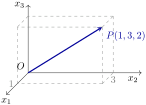
Example 6.5 .
Compute
\(\lVert\overrightarrow{OP}\rVert\) where
\(P=(1,3,2)\text{.}\)
Example 6.6 .
Let
\(\lVert\vec u\rVert=5\text{,}\) \(\lVert\vec v\rVert=\sqrt{3}\text{,}\) and
\(\vec u\cdot\vec v=-1\text{.}\) Compute
\(\lVert\vec u+\vec v\rVert\text{.}\)
For any vector
\(\vec v\) and scalar
\(c\text{,}\)
\begin{equation*}
\| c\vec v\| = \lvert c\rvert\|\vec v\|.
\end{equation*}
Definition 6.7 . Unit Vector.
A vector of length 1 is called a
unit vector .
Examples of unit vectors:
\begin{equation*}
\vec e_1=\begin{bmatrix}1\\0\end{bmatrix},\quad
\vec y=\frac{1}{\sqrt{5}}\begin{bmatrix}1\\2\end{bmatrix},\quad
\vec v=\frac{1}{3}\begin{bmatrix}2\\1\\2\end{bmatrix}.
\end{equation*}
Definition 6.8 . Distance.
For
\(\vec u,\vec v\in\mathbb{R}^n\text{,}\) the
distance between them is
\begin{equation*}
\operatorname{dist}(\vec u,\vec v)=\lVert\vec u-\vec v\rVert.
\end{equation*}
Example 6.9 .
Compute the distance between
\(\vec u=\begin{bmatrix}7\\1\end{bmatrix}\) and
\(\vec v=\begin{bmatrix}3\\2\end{bmatrix}\text{.}\)
Definition 6.10 . Orthogonal Vectors.
Two vectors
\(\vec u,\vec v\) are
orthogonal if
\(\vec u\cdot\vec v=0\text{.}\)
\begin{equation*}
\| \vec u+\vec v\|^2
= \|\vec u\|^2 + \|\vec v\|^2.
\end{equation*}
The zero vector is orthogonal to every vector in
\(\mathbb{R}^n\text{.}\)
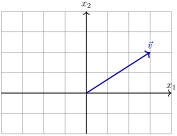
Example 6.11 .
Sketch the set of all vectors orthogonal to
\(\vec v=\begin{bmatrix}3\\2\end{bmatrix}\text{.}\)
Definition 6.12 . Orthogonal Complement.
If
\(W\) is a subspace of
\(\mathbb{R}^n\text{,}\) a vector
\(\vec z\) is
orthogonal to
\(W\) if
\(\vec z\cdot\vec w=0\) for every
\(\vec w\in W\text{.}\) The set of all such vectors is the
orthogonal complement :
\begin{equation*}
W^\perp=\{\vec z\in\mathbb{R}^n:\vec z\cdot\vec w=0 \;\text{for all}\; \vec w\in W\}.
\end{equation*}
The set \(W^\perp\) is also a subspace of \(\mathbb{R}^n\text{.}\) We have that
\begin{equation*}
\dim(W) + \dim(W^\perp) = n\text{.}
\end{equation*}
Furthermore, for any subspace \(W\text{,}\) we have that \(\left(W^\perp\right)^\perp = W\text{.}\)
Example 6.13 .
Suppose
\(A=\begin{bmatrix}1 \amp 3\\ 2 \amp 6\end{bmatrix}\text{.}\) Find
\(\Nul(A)^\perp\text{.}\)
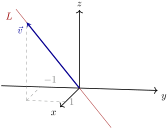
Example 6.14 .
Let
\(L\) be the line spanned by
\(\vec v=\begin{bmatrix}1\\-1\\2\end{bmatrix}\text{.}\) Since
\(L\) is 1-dimensional, its orthogonal complement
\(L^\perp\) is a plane. Find an equation for the plane
\(L^\perp\text{.}\)
Definition 6.15 . Row Space.
The
row space \(\operatorname{Row}(A)\) is the subspace spanned by the rows of a matrix
\(A\text{.}\)
\(\dim(\operatorname{Row}(A))=\dim(\operatorname{Col}(A))\text{.}\)
A basis for \(\operatorname{Row}(A)\) is given by the pivot rows of \(A\text{.}\)
In general, \(\operatorname{Row}(A)\) and \(\operatorname{Col}(A)\) are unrelated spaces.
Example 6.16 .
Describe
\(\Nul(A) \subseteq \mathbb{R}^n\) in terms of an orthogonal subspace.
\(\vec x\in\Nul(A)\) if and only if \(\underline{\hspace{2in}}\text{.}\)
This means \(\vec x\) is \(\underline{\hspace{2in}}\) to each row of \(A\text{.}\)
Therefore \(\operatorname{Row}(A)\) is \(\underline{\hspace{3in}}\) of \(\Nul(A)\text{.}\)
\(\dim(\operatorname{Row}(A))+\dim(\Nul(A))=\underline{\hspace{1in}}\text{.}\)
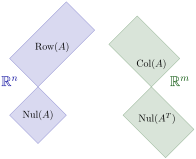
Theorem 6.17 . The Four Subspaces.
For any
\(A\in\mathbb{R}^{m\times n}\text{:}\)
\(\Nul(A)\) is the orthogonal complement of
\(\operatorname{Row}(A)\text{:}\)
\begin{equation*}
\Row(A)^\perp = \Nul(A) \quad \text{and} \quad \Nul(A)^\perp = \Row(A)
\end{equation*}
\(\Nul(A^T)\) is the orthogonal complement of
\(\operatorname{Col}(A)\text{:}\)
\begin{equation*}
\Col(A)^\perp = \Nul(A^T) \quad \text{and} \quad \Nul(A^T)^\perp = \Col(A)
\end{equation*}
This geometric structure is often shown using overlapping regions representing the four fundamental subspaces.
Theorem 6.18 . Dot Product and Angle.
The dot product satisfies
\begin{equation*}
\vec a\cdot\vec b=\lVert\vec a\rVert\,\lVert\vec b\rVert\cos\theta.
\end{equation*}
Thus, if
\(\vec a\cdot\vec b=0\text{,}\) then either one vector is the zero vector or the vectors are orthogonal.
Example 6.19 .
Find the angle between
\(\vec v = \begin{bmatrix} 3 \\ 4 \end{bmatrix}\) and
\(\vec u = \begin{bmatrix} \dfrac{3 - 4\sqrt{3}}{10} \\ \dfrac{4 + 3\sqrt{3}}{10} \end{bmatrix}\text{.}\) Note that
\(\vec u\) is a unit vector.