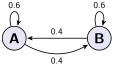
Note that
\(\det(P) = 0.6^2 - 0.4^2 = 0.2\) and
\(\operatorname{tr}(P) = 0.6 + 0.6 = 1.2\text{.}\) It follows by the result in
Example 5.17 that the characteristic polynomial of
\(P\) is
\begin{equation*}
\det(P-\lambda I) = \lambda^2 - \operatorname{tr}(P)\lambda + \det(P) = \lambda^2 -1.2\lambda + 0.2\text{.}
\end{equation*}
Setting the characteristic polynomial equal to 0, multiplying both sides by 5, and factoring yields:
\begin{equation*}
5\lambda^2 - 6\lambda + 1 = 0 \quad \implies \quad (\lambda - 1)(5\lambda - 1) = 0\text{.}
\end{equation*}
Therefore, the eigenvalues of \(P\) are \(\lambda_1 = 1\) and \(\lambda_2 = \frac{1}{5}\text{.}\) (We knew that \(\lambda = 1\) had to be an eigenvalue of \(P\) since \(P\) is a stochastic matrix.)
For \(\lambda_1 = 1\text{,}\) note that
\begin{equation*}
P - I = \begin{bmatrix} -0.4 \amp 0.4 \\ 0.4 \amp -0.4 \end{bmatrix} \sim \begin{bmatrix} 1\amp -1 \\ 0 \amp 0 \end{bmatrix}\text{.}
\end{equation*}
It follows that a nonzero vector in \(\Nul(P - I)\) is \(\vec v_1 = \begin{bmatrix} 1 \\ 1 \end{bmatrix}\text{.}\) Furthermore, since \(P - I\) had a single free variable, we have that
\begin{equation*}
1\text{-eigenspace}(P) = \Nul(P - I) = \Span\left\{\begin{bmatrix} 1 \\ 1 \end{bmatrix}\right\}\text{.}
\end{equation*}
For \(\lambda_2 = \frac{1}{5}\text{,}\) note that
\begin{equation*}
P - \frac{1}{5}I = P - 0.2I = \begin{bmatrix} 0.4 \amp 0.4 \\ 0.4 \amp 0.4 \end{bmatrix} \sim \begin{bmatrix} 1 \amp 1 \\ 0 \amp 0 \end{bmatrix}\text{.}
\end{equation*}
It follows that a nonzero vector in \(\Nul(P - \frac{1}{5}I)\) is \(\vec v_2 = \begin{bmatrix} 1 \\ -1 \end{bmatrix}\text{.}\) Furthermore, since \(P - \frac{1}{5}I\) had a single free variable, we have that
\begin{equation*}
\frac{1}{5}\text{-eigenspace}(P) = \Nul(P - \frac{1}{5}I) = \Span\left\{\begin{bmatrix} 1 \\ -1 \end{bmatrix}\right\}\text{.}
\end{equation*}