Skip to main content
Contents Embed Dark Mode Prev Up Next \(\newcommand{\foo}{b^{ar}}
\newcommand{\aug}{\fboxsep=-\fboxrule\!\!\!\fbox{\strut}\!\!\!}
\newcommand{\Nul}{\operatorname{Nul}}
\newcommand{\Col}{\operatorname{Col}}
\newcommand{\Row}{\operatorname{Row}}
\newcommand{\Span}{\operatorname{Span}}
\renewcommand{\det}{\operatorname{det}}
\newcommand{\rank}{\operatorname{rank}}
\newcommand{\proj}{\operatorname{proj}}
\newcommand{\dist}{\operatorname{dist}}
\newcommand{\lt}{<}
\newcommand{\gt}{>}
\newcommand{\amp}{&}
\definecolor{fillinmathshade}{gray}{0.9}
\newcommand{\fillinmath}[1]{\mathchoice{\colorbox{fillinmathshade}{$\displaystyle \phantom{\,#1\,}$}}{\colorbox{fillinmathshade}{$\textstyle \phantom{\,#1\,}$}}{\colorbox{fillinmathshade}{$\scriptstyle \phantom{\,#1\,}$}}{\colorbox{fillinmathshade}{$\scriptscriptstyle\phantom{\,#1\,}$}}}
\)
Section 2.9 Dimension and Rank
Handout 2.9 Dimension and Rank
Objectives: Topics
Objectives: Goals
Calculate coordinates of a vector in a given basis.
Characterize subspaces using the concept of dimension.
Characterize matrices using rank, column space, and null space.
Apply the Rank, Basis, and Invertibility Theorems to describe matrices and subspaces.
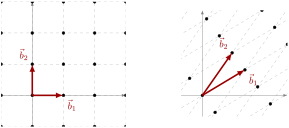
Key idea: Many different bases may be chosen for a given subspace. The choice can dramatically affect coordinate representations.
Example 2.57 .
Sketch
\(\vec b_1 + \vec b_2\) in each coordinate system below.
Two grids with different bases; vectors \(\vec b_1\) and \(\vec b_2\) are drawn.
Definition 2.58 . Coordinates Relative to a Basis.
Let
\(\mathcal{B}=\{\vec b_1,\dots,\vec b_p\}\) be a basis for a subspace
\(H\text{.}\) For any
\(\vec x\in H\text{,}\) the
coordinates of \(\vec x\) relative to \(\mathcal B\) are the scalars
\(c_1,\dots,c_p\) such that
\begin{equation*}
\vec x = c_1\vec b_1 + \cdots + c_p\vec b_p.
\end{equation*}
The
coordinate vector of \(\vec x\) relative to \(\mathcal B\) is:
\begin{equation*}
[\vec x]_{\mathcal B} =
\begin{bmatrix}
c_1\\ \vdots\\ c_p
\end{bmatrix}.
\end{equation*}
Example 2.59 .
\begin{equation*}
\vec v_1=\begin{bmatrix}1\\0\\1\end{bmatrix},\qquad
\vec v_2=\begin{bmatrix}1\\1\\1\end{bmatrix},\qquad
\vec x=\begin{bmatrix}5\\3\\5\end{bmatrix}.
\end{equation*}
Verify that
\(\vec x\) is in the span of
\(\mathcal B=\{\vec v_1,\vec v_2\}\text{,}\) and compute
\([\vec x]_{\mathcal B}\text{.}\)
Example 2.60 .
\begin{equation*}
\vec v_1=\begin{bmatrix}-1\\0\\1\\0\end{bmatrix},\qquad
\vec v_2=\begin{bmatrix}0\\1\\3\\2\end{bmatrix},\qquad
\vec v_3=\begin{bmatrix}3\\6\\2\\-1\end{bmatrix},\qquad
\vec x=\begin{bmatrix}3\\11\\4\\-4\end{bmatrix},
\end{equation*}
and
\(H = \textrm{Span}\{\vec v_1, \vec v_2, \vec v_3\}\text{.}\)
(a) Verify that
\(\mathcal B=\{\vec v_1,\vec v_2,\vec v_3\}\) is a basis for
\(H\text{.}\)
(b) Determine if
\(\vec x \in H\text{.}\)
(c) Compute
\([\vec x]_{\mathcal B}\text{.}\)
Definition 2.61 . Dimension.
The
dimension of a nonzero subspace
\(H\text{,}\) written
\(\operatorname{dim}(H)\text{,}\) is the number of vectors in any basis of
\(H\text{.}\) We define
\(\operatorname{dim}(\{0\})=0\text{.}\)
Theorem 2.62 . Dimension Is Well-Defined.
Any two bases
\(\mathcal B_1\) and
\(\mathcal B_2\) of a nonzero subspace
\(H\) have the same number of vectors.
Definition 2.64 . Rank.
The
rank of a matrix
\(A\) is the dimension of its column space.
Example 2.65 .
Compute
\(\operatorname{rank}(A)\) and
\(\operatorname{dim}(\operatorname{Nul}A)\) and find a basis for
\(\Col(A)\) and
\(\Nul(A)\text{,}\) where
\begin{equation*}
A = \begin{bmatrix}
2 \amp -3 \amp -12 \amp 4 \amp -7\\
4 \amp -5 \amp -22 \amp 3 \amp 1\\
-5 \amp 2 \amp 19 \amp -10 \amp -10\\
0 \amp 2 \amp 4 \amp 7 \amp -4
\end{bmatrix}
\sim
\begin{bmatrix}
1 \amp 0 \amp -3 \amp 0 \amp 8\\
0 \amp 1 \amp 2 \amp 0 \amp 5\\
0 \amp 0 \amp 0 \amp 1 \amp -2\\
0 \amp 0 \amp 0 \amp 0 \amp 0
\end{bmatrix}.
\end{equation*}
Theorem 2.66 . Rank Theorem.
If a matrix
\(A\) has
\(n\) columns, then
\begin{equation*}
\operatorname{rank}(A)+\operatorname{dim}(\operatorname{Null}A)=n.
\end{equation*}
Theorem 2.67 . Basis Theorem.
Any two bases for a subspace have the same number of vectors. That common number of vectors is the dimension of the subspace.
Theorem 2.68 . The Invertible Matrix Theorem (Continued).
Let
\(A\) be an
\(n\times n\) matrix. The following are equivalent:
(a) \(A\) is invertible.
(m) The columns of \(A\) form a basis for \(\mathbb{R}^n\text{.}\)
(n) \(\operatorname{Col}A=\mathbb{R}^n\text{.}\)
(o) \(\operatorname{dim}\operatorname{Col}A=n\text{.}\)
(p) \(\operatorname{rank}A=n\text{.}\)
(q) \(\operatorname{Nul}A=\{\vec 0\}\text{.}\)
(r) \(\operatorname{dim}\operatorname{Nul}A=0\text{.}\)
Example 2.69 .
For each part below, give an example of a
\(2\times 3\) matrix
\(A\) in RREF with the stated property, if possible.
(a)
\(\operatorname{rank}(A)=3\)
(b)
\(\operatorname{rank}(A)=2\)
(c)
\(\operatorname{dim}(\operatorname{Null}A)=2\)
(d)
\(\operatorname{Nul}(A)=\{\vec 0\}\)