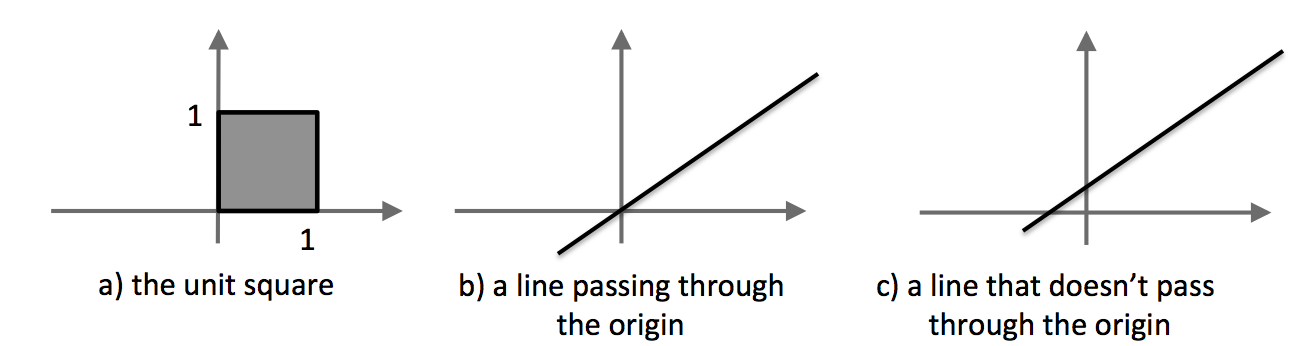
The following subsets of \(\mathbb{R}^2\) are written in set-builder notation. For each, determine if it is a subspace of \(\mathbb{R}^2\text{.}\) Note that \(\mathbb{Z} = \{\dots, -2, -1, 0, 1 , 2, \dots\}\) is the set of integers.
Recall that for vectors \(\vec v_1,\dots,\vec v_p\in\mathbb{R}^n\text{,}\)\(\operatorname{Span}\{\vec v_1,\dots,\vec v_p\}\) is the subspace consisting of all linear combinations of these vectors. Not only is the span of vectors an example of a subspace of \(\mathbb{R}^n\text{,}\) they are the only examples of subspace of \(\mathbb{R}^n\text{.}\)
Every subspace of \(\mathbb{R}^n\) can be written as the span of a finite number of vectors; that is, if \(H\) is a subspace of \(\mathbb{R}^n\text{,}\) then there exists vectors \(\vec v_1, \dots, \vec v_k\) so that \(H = \operatorname{Span}\left\{\vec v_1, \dots, \vec v_n\right\}\text{.}\)
The null space of \(A\text{,}\)\(\operatorname{Nul}(A)\text{,}\) is the subspace of \(\mathbb{R}^n\) consisting of all solutions to \(A\vec x=\vec 0\text{.}\)
Let \(A\) be an \(m \times n\) matrix, and let \(B\) be any matrix which is row equivalent to \(A\text{.}\) Then
The subspaces \(\operatorname{Col}(A)\) and \(\operatorname{Col}(B)\) are most likely different. So, often, \(\operatorname{Col}(A) \neq \operatorname{Col}(B)\text{.}\)
The subspaces \(\operatorname{Nul}(A)\) and \(\operatorname{Nul}(B)\) are always the same. So, it is always true that \(\operatorname{Nul}(A) = \operatorname{Nul}(B)\text{.}\)
In MATH 1554, each basis will be a finite set of vectors. For every subspace other than the trivial subspace \(\left\{\vec 0\right\}\text{,}\) there are infinitely many choices for the basis.
Be careful to NEVER include \(\Span\) when writing your basis. Writing \(\Span\) of the basis gives the entire subspace. A basis is NOT the entire subspace, but a finite set of building blocks used to build the space.