Skip to main content
Contents Embed Dark Mode Prev Up Next \(\newcommand{\foo}{b^{ar}}
\newcommand{\aug}{\fboxsep=-\fboxrule\!\!\!\fbox{\strut}\!\!\!}
\newcommand{\Nul}{\operatorname{Nul}}
\newcommand{\Col}{\operatorname{Col}}
\newcommand{\Row}{\operatorname{Row}}
\newcommand{\Span}{\operatorname{Span}}
\renewcommand{\det}{\operatorname{det}}
\newcommand{\rank}{\operatorname{rank}}
\newcommand{\proj}{\operatorname{proj}}
\newcommand{\dist}{\operatorname{dist}}
\newcommand{\lt}{<}
\newcommand{\gt}{>}
\newcommand{\amp}{&}
\definecolor{fillinmathshade}{gray}{0.9}
\newcommand{\fillinmath}[1]{\mathchoice{\colorbox{fillinmathshade}{$\displaystyle \phantom{\,#1\,}$}}{\colorbox{fillinmathshade}{$\textstyle \phantom{\,#1\,}$}}{\colorbox{fillinmathshade}{$\scriptstyle \phantom{\,#1\,}$}}{\colorbox{fillinmathshade}{$\scriptscriptstyle\phantom{\,#1\,}$}}}
\)
Section 2.1 Matrix Operations
Handout 2.1 Matrix Operations
Objectives: Topics
Identity and zero matrices
Matrix algebra (sums and products, scalar multiplies, matrix powers)
Transpose of a matrix
Objectives: Goals
Apply matrix algebra, the matrix transpose, and the zero and identity matrices, to solve and analyze matrix equations.
Definition 2.1 . Zero Matrix.
A
zero matrix is any matrix whose every entry is zero.
\begin{equation*}
0_{2\times 3}=
\begin{bmatrix}
0 \amp 0 \amp 0\\
0 \amp 0 \amp 0
\end{bmatrix},
\qquad
0_{2\times 1}=
\begin{bmatrix}
0\\
0
\end{bmatrix}.
\end{equation*}
Definition 2.2 . Identity Matrix.
The
\(n\times n\) identity matrix has ones on the main diagonal and zeros elsewhere.
\begin{equation*}
I_2=
\begin{bmatrix}
1 \amp 0\\
0 \amp 1
\end{bmatrix},
\qquad
I_3=
\begin{bmatrix}
1 \amp 0 \amp 0\\
0 \amp 1 \amp 0\\
0 \amp 0 \amp 1
\end{bmatrix}.
\end{equation*}
Note: Any matrix with dimensions
\(n\times n\) is
square . Zero matrices need not be square; identity matrices must be square.
Suppose
\(A\in\mathbb{R}^{m\times n}\text{,}\) and
\(a_{i,j}\) is the element of
\(A\) in row
\(i\) and column
\(j\text{.}\)
If
\(A\) and
\(B\) are
\(m\times n\) matrices, then the elements of
\(A+B\) are
\(a_{i,j}+b_{i,j}\text{.}\)
If
\(c\in\mathbb{R}\text{,}\) then the elements of
\(cA\) are
\(c\,a_{i,j}\text{.}\)
Example 2.3 .
\begin{equation*}
\begin{bmatrix}
1 \amp 2 \amp 3\\
4 \amp 5 \amp 6
\end{bmatrix}
+ c
\begin{bmatrix}
7 \amp 4 \amp 7\\
0 \amp 0 \amp k
\end{bmatrix}
=
\begin{bmatrix}
15 \amp 10 \amp 17\\
4 \amp 5 \amp 16
\end{bmatrix},
\end{equation*}
what are the values of
\(c\) and
\(k\text{?}\)
Scalar multiples and matrix addition have the expected properties. If
\(r,s\in\mathbb{R}\) are scalars and
\(A,B,C\) are
\(m\times n\) matrices, then:
\(\displaystyle A + 0_{m\times n} = A\)
\(\displaystyle (A+B)+C = A+(B+C)\)
\(\displaystyle r(A+B)=rA+rB\)
\(\displaystyle (r+s)A = rA + sA\)
\(\displaystyle r(sA) = (rs)A\)
Definition 2.4 . Matrix Product via Columns.
Let
\(A\) be an
\(m\times n\) matrix and
\(B\) be an
\(n\times p\) matrix. The product
\(AB\) is an
\(m\times p\) matrix, given by
\begin{equation*}
AB
=
A
\begin{bmatrix}
\vec b_1 \amp \cdots \amp \vec b_p
\end{bmatrix}
=
\begin{bmatrix}
A\vec b_1 \amp \cdots \amp A\vec b_p
\end{bmatrix}.
\end{equation*}
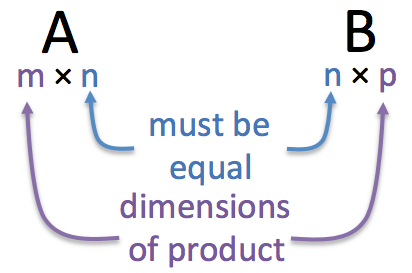
Note: The dimensions of
\(A\) and
\(B\) determine whether
\(AB\) is defined, and what its dimensions will be.
A visual guide to when \(AB\) is defined based on inner dimensions.
Theorem 2.5 . Row-Column Rule for Matrix Multiplication.
If
\(A\in\mathbb{R}^{m\times n}\) has rows
\(\vec a_i\) and
\(B\in\mathbb{R}^{n\times p}\) has columns
\(\vec b_j\text{,}\) then each element of
\(C=AB\) is
\begin{equation*}
c_{ij}=\vec a_i\cdot \vec b_j.
\end{equation*}
Example 2.6 .
Compute the following using the row-column method.
\begin{equation*}
C=AB=
\begin{bmatrix}
2 \amp 0\\
1 \amp -1
\end{bmatrix}
\begin{bmatrix}
3 \amp 0 \amp 1\\
4 \amp 5 \amp 6
\end{bmatrix}.
\end{equation*}
Theorem 2.7 . Properties and Warnings.
Let
\(A,B,C\) be matrices of sizes needed for the products to be defined, and suppose
\(A\) is
\(m\times n\text{.}\)
Associative: \((AB)C = A(BC)\)
Left distributive: \(A(B+C)=AB+AC\)
Right distributive: \((A+B)C = AC + BC\)
Identity: \(I_m A = A I_n\)
Non-commutative: In general,
\(AB\neq BA\text{.}\)
Non-cancellation: \(AB=AC\) does not imply
\(B=C\text{.}\)
Zero divisors: \(AB=0\) does not imply
\(A=0\) or
\(B=0\text{.}\)
The associative property is
\((AB)C = A(BC)\text{.}\) If
\(C=\vec x\text{,}\) then:
\begin{equation*}
(AB)\vec x = A(B\vec x).
\end{equation*}
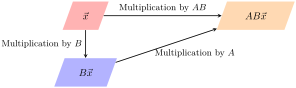
Diagram showing two ways of getting from \(\vec x\) to \(AB\vec x\text{,}\) either by \(\vec x \mapsto B\vec x \mapsto AB\vec x\) or by direct multiplication by \(\vec x \mapsto AB\vec x\text{.}\)
The product
\(AB\vec x\) can be obtained either by multiplying by
\(AB\text{,}\) or by multiplying by
\(B\) and then by
\(A\text{.}\) This corresponds to
composition of linear transformations .
Example 2.8 .
\begin{equation*}
A=
\begin{bmatrix}
1 \amp 1\\
0 \amp 0
\end{bmatrix}.
\end{equation*}
Give an example of a
\(2\times 2\) matrix
\(B\) such that
\(AB\neq BA\text{.}\)
Definition 2.9 . Transpose.
The
transpose \(A^T\) is the matrix whose columns are the rows of
\(A\text{.}\)
Example 2.10 .
\begin{equation*}
A = \begin{bmatrix}
1 \amp 2 \amp 3 \amp 4 \amp 5\\
0 \amp 1 \amp 0 \amp 2 \amp 0
\end{bmatrix}^T
\end{equation*}
Theorem 2.11 . Properties of Matrix Transpose.
\((A^T)^T =\) \(A\)
\((A+B)^T =\) \(A^T + B^T\)
\((rA)^T =\) \(rA^T\)
\((AB)^T =\) \(B^TA^T\)
Example 2.12 .
\begin{equation*}
A=
\begin{bmatrix}
1 \amp 0\\
0 \amp 0
\end{bmatrix},
\qquad
B=
\begin{bmatrix}
1 \amp 0 \amp 0\\
0 \amp 0 \amp 8
\end{bmatrix},
\qquad
C=
\begin{bmatrix}
1 \amp 0 \amp 0\\
0 \amp 2 \amp 0\\
0 \amp 0 \amp 2
\end{bmatrix}.
\end{equation*}
Which of these operations are defined, and what are the dimensions of the result?
(a)
(b)
(c)
For any
\(n\times n\) matrix and positive integer
\(k\text{,}\) \(A^k\) is the product of
\(k\) copies of
\(A\text{.}\)
\begin{equation*}
A^k = AA\cdots A.
\end{equation*}
Example 2.13 .
Compute \(A^2\) for
\begin{equation*}
A = \begin{bmatrix} 3 \amp -2 \\ 5 \amp 1 \end{bmatrix}
\end{equation*}
Example 2.14 .
\begin{equation*}
B=
\begin{bmatrix}
1 \amp 0 \amp 0\\
0 \amp 2 \amp 0\\
0 \amp 0 \amp 2
\end{bmatrix}.
\end{equation*}
Example 2.15 .
True or False. If false, explain briefly.
(a) Let
\(n \in \mathbb{R}\text{.}\) Then for any
\(n \times n\) matrix
\(\text{,}\) we have
\((I_n + A)(I_n - A) = I_n - A^2\text{.}\)
(b) Let
\(n \in \mathbb{R}\text{.}\) For any
\(n \times n\) matrices
\(A\) and
\(B\text{,}\) we have
\((A+B)^2 = A^2 + B^2 + 2AB\text{.}\)