Let us determine
\(A\) such that
\(T(\vec x) = A\vec x \) is rotation by
\(\theta\) degrees counterclockwise. By
Theorem 1.58, we need to determine
\(T\left(\begin{bmatrix} 1 \\ 0 \end{bmatrix}\right)\) and
\(T\left(\begin{bmatrix} 0 \\ 1 \end{bmatrix}\right)\text{.}\)
First, note that \(T\left(\begin{bmatrix} 1 \\ 0 \end{bmatrix}\right)\) is the vector in \(\mathbb{R}^2\) obtained by rotating the vector \(\begin{bmatrix} 1 \\ 0 \end{bmatrix}\text{,}\) which points in the direction of \(0^\circ\text{,}\) by \(\theta\) degrees counterclockwise. The resulting vector would have terminal end at the point on the unit circle whose angle is \(\theta\text{.}\) Using trigonometry, this point is \((\cos(\theta), \sin(\theta))\text{.}\) Therefore, we have that
\begin{equation*}
T\left(\begin{bmatrix}1 \\ 0 \end{bmatrix}\right) = \begin{bmatrix} \cos(\theta) \\ \sin(\theta) \end{bmatrix}\text{.}
\end{equation*}
Next, note that \(T\left(\begin{bmatrix} 0 \\ 1 \end{bmatrix}\right)\) is the vector in \(\mathbb{R}^2\) obtained by rotating the vector \(\begin{bmatrix} 0 \\ 1 \end{bmatrix}\text{,}\) which points in the direction of \(90^\circ\text{,}\) by \(\theta\) degrees counterclockwise. The resulting vector would have terminal end at the point on the unit circle whose angle is \(90^\circ + \theta\text{.}\) It follows that this terminal point is \((\cos(90^\circ + \theta), \sin(90^\circ + \theta))\text{.}\) Using the sum rule for sine and cosine, we see that this terminal point can be expressed as \((-\sin(\theta), \cos(\theta))\text{.}\) Therefore, we have that
\begin{equation*}
T\left(\begin{bmatrix} 0 \\ 1 \end{bmatrix}\right) = \begin{bmatrix} -\sin(\theta) \\ \cos(\theta) \end{bmatrix}\text{.}
\end{equation*}
Thus, we have that the matrix \(A \) so that \(T(\vec x) = A\vec x \) results in rotating the vector \(\vec x\) by \(\theta\) degrees counterclockwise is
\begin{equation*}
A = \begin{bmatrix} \cos(\theta) \amp -\sin(\theta) \\ \sin(\theta) \amp \cos(\theta) \end{bmatrix}\text{.}
\end{equation*}
Let’s choose "nice" values of \(\theta\) to test out our matrix \(A\text{.}\)
-
If \(\theta = 0^\circ\text{,}\) then
\begin{equation*}
A = \begin{bmatrix} \cos(0^\circ) \amp -\sin(0^\circ) \\ \sin(0^\circ) \amp \cos(0^\circ) \end{bmatrix} = \begin{bmatrix} 1 \amp 0 \\ 0 \amp 1 \end{bmatrix}\text{.}
\end{equation*}
Note that \(T(\vec x) = A\vec x = \vec x\) for all \(\vec x \in \mathbb{R}^2\text{,}\) so \(T\) does not change any input vector \(\vec x\text{.}\) This makes sense since rotating a vector by \(0^\circ\) doesn’t change the vector.
-
If \(\theta = 180^\circ\text{,}\) then
\begin{equation*}
A = \begin{bmatrix} \cos(180^\circ) \amp -\sin(180^\circ) \\ \sin(180^\circ) \amp \cos(180^\circ) \end{bmatrix} = \begin{bmatrix} -1 \amp 0 \\ 0 \amp -1 \end{bmatrix}\text{.}
\end{equation*}
Note that \(T(\vec x) = A\vec x = -\vec x\) for all \(\vec x \in \mathbb{R}^2\text{,}\) so \(T\) makes each vector \(\vec x\) point in the opposite direction. This makes sense since rotating a vector by \(180^\circ\) also makes vectors point in the opposite direction.
-
If \(\theta = 90^\circ\text{,}\) then
\begin{equation*}
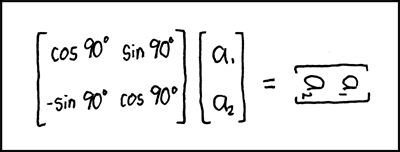
A = \begin{bmatrix} \cos(90^\circ) \amp -\sin(90^\circ) \\ \sin(90^\circ) \amp \cos(90^\circ) \end{bmatrix} = \begin{bmatrix} 0 \amp -1 \\ 1 \amp 0 \end{bmatrix}\text{.}
\end{equation*}
To see if \(T(\vec x) = A\vec x\) actually does rotate vectors counterclockwise by \(90^\circ\text{,}\) let’s calculate \(T(\vec x)\) for some special \(\vec x \in \mathbb{R}^2\text{.}\)
-
\(\vec x\) pointing in the direction of
\(0^\circ\text{:}\)
\begin{equation*}
T\left(\begin{bmatrix} 1 \\ 0 \end{bmatrix}\right) = \begin{bmatrix} 0 \amp -1 \\ 1 \amp 0 \end{bmatrix}\begin{bmatrix} 1 \\ 0 \end{bmatrix} = \begin{bmatrix} 0 \\ 1 \end{bmatrix}
\end{equation*}
which points in the direction of
\(90^\circ\)
-
\(\vec x\) pointing in the direction of
\(90^\circ\text{:}\)
\begin{equation*}
T\left(\begin{bmatrix} 0 \\ 1 \end{bmatrix}\right) = \begin{bmatrix} 0 \amp -1 \\ 1 \amp 0 \end{bmatrix}\begin{bmatrix} 0 \\ 1 \end{bmatrix} = \begin{bmatrix} -1 \\ 0 \end{bmatrix}
\end{equation*}
which points in the direction of
\(180^\circ\)
-
\(\vec x\) pointing in the direction of
\(30^\circ\text{:}\)
\begin{equation*}
T\left(\begin{bmatrix} \frac{\sqrt{3}}{2} \\ \frac{1}{2} \end{bmatrix}\right) = \begin{bmatrix} 0 \amp -1 \\ 1 \amp 0 \end{bmatrix}\begin{bmatrix} \frac{\sqrt{3}}{2} \\ \frac{1}{2} \end{bmatrix} = \begin{bmatrix} -\frac{1}{2} \\ \frac{\sqrt{3}}{2} \end{bmatrix}
\end{equation*}
which points in the direction of
\(120^\circ\)
-
\(\vec x\) pointing in the direction of
\(45^\circ\text{:}\)
\begin{equation*}
T\left(\begin{bmatrix} \frac{\sqrt{2}}{2} \\ \frac{\sqrt{2}}{2} \end{bmatrix}\right) = \begin{bmatrix} 0 \amp -1 \\ 1 \amp 0 \end{bmatrix}\begin{bmatrix} \frac{\sqrt{2}}{2} \\ \frac{\sqrt{2}}{2} \end{bmatrix} = \begin{bmatrix} -\frac{\sqrt{2}}{2} \\ \frac{\sqrt{2}}{2} \end{bmatrix}
\end{equation*}
which points in the direction of
\(135^\circ\)
These four examples provide evidence supporting that \(T(\vec x) = A\vec x\) is rotating vectors counterclockwise by \(90^\circ\text{.}\)